
Friday, 27 February 2015
Deadlifts - 5 Most Common Deadlift Mistakes
Following on from my post yesterday, I have found this video for you which shows the deadlift mistakes - really emphasises some of my points but nothing like a video to look at the issues more closely.

Thursday, 26 February 2015
Deadlift - What Not to Do
The deadlift - quite simply one of the best exercises for getting stronger and slimmer. A multi-functional compound exercise which hits so many areas - lower back, hamstrings, quads, forearms and grip, shoulders and so on.
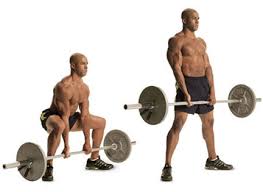
Yet the toll on your lower back means proceed with caution.
1 Ensure you're fully warmed up - say 5+ mins on the rowing machine plus some air squats plus movement exercises to get the spine limbered up
2 Then practice air dead lifts - simulate the movement without the bar. Do this at speed to help the warm up process.
3 Ensure good form - posterior moves out but make sure you get the bowing position and not the sitting on the toilet mode used for a a barbell squat! That way you're engaging the hamstrings more to assist and taking less strain on the lower back. Chest puffed out, head looking straight ahead at all times.
4 Critically , if you're new to this, keep the weight really low. Almost weedy levels- 1/2 your body weight or lower. Do 3 sets of say 5 reps at first. Week 2 go for 4 sets of that weight. Week 3 5 sets and then stay there.
5 Now here's the crucial bit (as for any weight training) - never add too much incremental weight. I believe you should add no more than 2.5kg each week i.e. 1.25kg weight plates on each end. You may think you can do more but don't. The deadlift has a nasty way of reminding you that you overdid 1 or 2 days later when the DOMS strike (delayed onset of muscle soreness). When it hits your lower back it makes your life really difficult for a while.
6 Warm down with stretches - the spinal bend is helpful as are quad and hamstring stretches.
So today I turn up at the gym having now got to 1 x bodyweight (the ultimate target is 2 x body weight). And after warming up ok, what do I do? I add reps to each set. So far so good. I then get carried away and add 10 kg to the bar on my last set and still try to do 8 reps. On the 7th rep I suddenly feel a sharp pain in my lower back. Complete amateur time and I'm disgusted with myself.
Now I'm in injury repair mode. I managed to stop without dropping the bar so my digity at the gym remained in tact. I even put the weights back without demonstrating my discomfort. Had a long stretch, sauna and applied anti-inflam gel and cold spray (no ice available).
I hope this isn't going to be a long lay-off.
Now all I can do is reflect on how every weight training injury I've had is almost invariably because I have ignored my limitations and rushed my progress. So I repeat - 2.5kg max per week (if that) - don't start thinking it's too easy. Keep to that max and live to fight another day.
Happy training!
Tuesday, 24 February 2015
HIIT on the Curve
HIIT on the Curve
Does your gym have one?
Very rarely do I ever enthuse about gyms per se - I mostly use a gym because I need a convenient place to train not necessarily becuase of their equipment, most of which is useless.
Yet the Curve is one of those inventions which despite my initial scepticism really does add to a workout. It is in fact a treadmill with a difference. The belt is not powered by anything other than kinetic force i.e. your own momentum. Yes - it moves by you moving your feet.

As the name suggests it is a curved base so that you aim to run on the curve itself. This kind of simulates hill-running so that you are working that much harder. You brake by moving your feet to the back where it grinds to a halt (although to be honest I don't trust it or me to get that right and I use the handrails to get to the side plates if I need to). That said you can easily and simply move back to walking pace
This machine is absolutely perfect for HIIT - high intensity interval training (see earlier posts). Ireckon that for the average person 5 minutes is sll you need for a really intensive workout. I use it normally at the end of my session.
There is another up-side too. For those of you who have bad knees (sadly that very much includes me) the process of simulated hill running means you don't fully extend your legs (because of the gradient / curve) and that in turn means you massively reduce the jarring. Inthat sense it works better than real hill running because the track helps also to absorb leg shock. Add to this that you're not on it for that long then it simply is a great way of adding to your training with little time investment.
Happy training
Sunday, 22 February 2015
Training with Kids
Morning All
So that you know straight away, I have two sons, aged 12 and 10. Anyone with kids and a busy job will be aware of the challenge immediately for staying fit on weekends. I've given you my developing theory on sound-bite training (see last 2 posts) which is vital and wish I'd thought of it before!
But I also think that staying a member of a gym which is reasonably family orientated (not many are!) was also vital. When they were younger we booked them into the creche at Virgin Active. Just at the point when we were about to leave the gym (based on frustration over how quickly the creche couldn't cope with bored kids of a certain age) VA suddenly introduced a policy of allowing children over 8 to train with their parents (obviously not on weights).
Combined with the swimming pool, that gives a lot more options.
I now aim to take the boys swimming once a week. The harder job is retraining their mindsets to stop regarding a pool as play-time - necessary when they were younger to get them into a positive stance on swiming, and thinking of it as serious training. That is starting to happen particularly as they are both realising they are actually quite good. I no longer give them too big a head start when we race!
When I take them to the gym I am getting them into the habit of measuring performance in order to set targets. It's starting to happen slowly. While they're doing that I take the opportunity to have a serious HIIT session. Today I have just finished HIIT in the gym followed by 25 lengths of the pool. Those were the toughest lengths I think I've ever done!
So it can be done. You can't lose sight of the fact that you need to be a fun parent on weekends some of the time but I'm constantly trying to do that by ensuring they're active. Getting them away from their Xboxes is vital and I refuse to spend parent time joining in these computer games like some of my extended family do.
Instead I look at walks (nature reserves), cycling, cricket in the summer as well as the above. When they've done that they realise that this can be fun! My eldest even bought a pair of binoculars to get into walking more.
Take every opportunity to introduce your kids (and yourself!) to fresh air and activity. Remeber that is the best source of Vitamin D, vital for well-being, by a long way. Within that schedule consider how much you can push yourself too. Throw in some sound-bite training (on a cardio day how about sneaking in some burpees, box jumps and jump roping (skipping) or some shadow boxing?
Happy training!
So that you know straight away, I have two sons, aged 12 and 10. Anyone with kids and a busy job will be aware of the challenge immediately for staying fit on weekends. I've given you my developing theory on sound-bite training (see last 2 posts) which is vital and wish I'd thought of it before!
But I also think that staying a member of a gym which is reasonably family orientated (not many are!) was also vital. When they were younger we booked them into the creche at Virgin Active. Just at the point when we were about to leave the gym (based on frustration over how quickly the creche couldn't cope with bored kids of a certain age) VA suddenly introduced a policy of allowing children over 8 to train with their parents (obviously not on weights).
Combined with the swimming pool, that gives a lot more options.
I now aim to take the boys swimming once a week. The harder job is retraining their mindsets to stop regarding a pool as play-time - necessary when they were younger to get them into a positive stance on swiming, and thinking of it as serious training. That is starting to happen particularly as they are both realising they are actually quite good. I no longer give them too big a head start when we race!
When I take them to the gym I am getting them into the habit of measuring performance in order to set targets. It's starting to happen slowly. While they're doing that I take the opportunity to have a serious HIIT session. Today I have just finished HIIT in the gym followed by 25 lengths of the pool. Those were the toughest lengths I think I've ever done!
So it can be done. You can't lose sight of the fact that you need to be a fun parent on weekends some of the time but I'm constantly trying to do that by ensuring they're active. Getting them away from their Xboxes is vital and I refuse to spend parent time joining in these computer games like some of my extended family do.
Instead I look at walks (nature reserves), cycling, cricket in the summer as well as the above. When they've done that they realise that this can be fun! My eldest even bought a pair of binoculars to get into walking more.
Take every opportunity to introduce your kids (and yourself!) to fresh air and activity. Remeber that is the best source of Vitamin D, vital for well-being, by a long way. Within that schedule consider how much you can push yourself too. Throw in some sound-bite training (on a cardio day how about sneaking in some burpees, box jumps and jump roping (skipping) or some shadow boxing?
Happy training!
Saturday, 21 February 2015
Sound-bite Training
I've mentioned it a couple of times before, including in yesterday's post. What exactly is sound-bite training? A sound-bite is a term that is used in radio and TV programming. It works on the principle that broadcasting time is ultra precious and there is little time to waffle usually (despite the average politician's attempts to do so).
So to ensure you maximise what little time is given to you, a competent speaker needs to make use of sound-bites i.e. hard hitting words and phrases designed to stay in the conscious recall of the listener. He makes his point using very succinct and confined words.
I have unashamedly borrowed that language for home training. Let's get real - despite knowing that you need to do more exercise, you have massive competing pressures on your time. If you have a busy full-time job, are a parent which takes account of most of your non-working time, have a house to maintain etc etc then training time is short and sweet. It may be that you can build some training into your leisure time, especially as the kids get older eg take them swimming (which I aim to do once each weekend) or go cycling (but are they able to go at a speed which is of real benefit to you?-in my case they're not at this stage.
So how do you fit in more exercise. Enter sound-bite training. You take no real time out at all but instead squeeze in body-weight training and hiit training in your spare moments throughout the day. You might even need to spread out the sets to achieve this. But see the day as a continuous training possibility.
If you come across say a kids playground whilst on a walk, why not squeeze out some pull-ups or chin-ups? When I'm at home and the coast is clear, I will sneak into the garden and use the tower for chin-ups and dips. Then squeeze in some push-ups at another point (as mentioned yesterday - a range of classic push-ups, diamonds and crucifix push ups). Maybe some leg training at another point - air squats, alternating lunges and assisted (balance wise) pistol squats. Maybe another point do some bridges and pike presses
To be clear - I am not saying that this replaces proper gym sessions with a longer and perhaps more intensive structure. This works as a complementary. It also works to supplement as well - for example, tomorrow i will take my boys swimming (unlike cycling I have to work a bit harder now when we race and can do my own thing a little easier) and then I might sneak in some sound-bite boxing later.
Happy training!
So to ensure you maximise what little time is given to you, a competent speaker needs to make use of sound-bites i.e. hard hitting words and phrases designed to stay in the conscious recall of the listener. He makes his point using very succinct and confined words.
I have unashamedly borrowed that language for home training. Let's get real - despite knowing that you need to do more exercise, you have massive competing pressures on your time. If you have a busy full-time job, are a parent which takes account of most of your non-working time, have a house to maintain etc etc then training time is short and sweet. It may be that you can build some training into your leisure time, especially as the kids get older eg take them swimming (which I aim to do once each weekend) or go cycling (but are they able to go at a speed which is of real benefit to you?-in my case they're not at this stage.
So how do you fit in more exercise. Enter sound-bite training. You take no real time out at all but instead squeeze in body-weight training and hiit training in your spare moments throughout the day. You might even need to spread out the sets to achieve this. But see the day as a continuous training possibility.
If you come across say a kids playground whilst on a walk, why not squeeze out some pull-ups or chin-ups? When I'm at home and the coast is clear, I will sneak into the garden and use the tower for chin-ups and dips. Then squeeze in some push-ups at another point (as mentioned yesterday - a range of classic push-ups, diamonds and crucifix push ups). Maybe some leg training at another point - air squats, alternating lunges and assisted (balance wise) pistol squats. Maybe another point do some bridges and pike presses
To be clear - I am not saying that this replaces proper gym sessions with a longer and perhaps more intensive structure. This works as a complementary. It also works to supplement as well - for example, tomorrow i will take my boys swimming (unlike cycling I have to work a bit harder now when we race and can do my own thing a little easier) and then I might sneak in some sound-bite boxing later.
Happy training!
Friday, 20 February 2015
Holiday Training
Hi All
Apologies for air silence - just been on holiday to Norfolk. Great week in a great property but have to confess my training didn't go as well as I hoped.
The main reason is tha there is too much going on - from gooig out on trips to famly cooking - training time is limited However i did get out on the kayak a couple of times which is great exrcise. I also used the sound bite method -just slotting in small pieces into quiet moments.
Push ups and pike presses were easy to be able to do. I go for as many as classic as ican do in 1st set and then a combo of classic, diamond and crucifix presses therafter in a super-set. After a few sets i have goe to exhaustion. The same with legs - a super set of classic air squats, luges and then balance assisted pistol squats will make the legs work hard.
I always look in a rented property for a hanging prop that will take my weight or the gym rigs I have with me. In this case a pergola outside was perfect for chin ups and hanging leg raises (on latter once I've gone to exhaustion then I switch to seated V raises.
Anyway - tomorrow its back for a proper gym session!
Wednesday, 11 February 2015
SPRINTING: THE PUREST, MOST POWERFUL PHYSIQUE-SHAPER IN AN ATHLETE'S ARSENAL:
If you were to ask me to pick one form of exercise and say that - for as long as I lived, for the remainder of my days - I could do as much of it as I wanted, whenever I wanted, but could never work out any other way, why, I'd look you right in the face and say "sex."
But then you'd probably say sex doesn't count, and that it's not a valid form of exercise, to which I'd probably reply "oh the hell it ain't," and then we'd probably end up getting into a really long, heated argument about it.
But - as a fictional hypothetical - let's assume you win that dispute, and force me to pick again. Well if that were the case, it wouldn't take me long to reply "sprinting," because'deep down'I'd know I made the right choice.
Of course I'm being slightly facetious, but I think I may have also piqued a few people's interest. Especially those of you who typically scoff at HIIT, run 6-day weight splits, and haven't done cardio since the Presidential Physical Fitness Test's timed mile back in middle school.
Think about it. I, of all people, have one of the most unhealthy, obsessive fixations on being supra-physiologically ripped and cut. "And yet even in spite of this Loki," you ask, "you would be willing to leave the iron behind for all eternity?"
Yup. Because if I knew I could sprint whenever and however it pleased me, I know I'd be juuuuuuust fine - maybe not all that big, but fine (perhaps even "damn-fine").
SPRINTING: THE COURVOISIER OF CARDIO
When it comes to cutting you up and promoting a nutrient-partitioning milieu conducive to building and maintaining a lean, muscular physique, sprinting simply cannot be beat. A simple look at competitive athletics demonstrates this pretty clearly.
I am NOT even talking about PRO-athletics, a world rife with performance-enhancing-drug use, one-in-a-million-gene-possessing individuals who are able to log hours of gym-time every day while being tended to by a virtual cadre of trainers, coaches, dieticians and sports-specialists.
No, instead just think back to your high-school days (unless you were home-schooled, in which case may someone have mercy on your sad, coddled soul, because you're just going to have to skip a few sentences).
Okay - mild genetic-selectivity aside - who were the most ripped (i.e. lowest amount of bodyfat relative to the amount of lean body mass carried) guys on your football team? The running backs, wide receivers and defensive backs, right? Track team? Jumpers and guys who ran events 400m and shorter. Basketball team guards?
Almost none of the guys or girls whose athletic livelihoods depended on their being able to sprint at maximal or near-maximal speed (causing them to thereby hone their anaerobic threshold in the process) ever had an appreciable amount of bodyfat on their frames during their playing days.
Most folks (while speeding by the track on the way to the weight-room) still mistakenly attribute this phenomenon to simple 'ectomorphism.' Well I, Loki, shall not tolerate it any longer, and that is why I have come to preach the gospel of "going really fast with your feet."
The fact of the matter is, those kids' physiques may have been influenced by 'ectomorphism,' but they were influenced a whole helluva' lot more by "the big A's" when it comes to nutrient-partitioning, fat oxidation and physique-augmentation:
- 5'-AMP-mediated protein kinase (AMPk)
- Acetyl-CoA carboxylase (ACC) and
- ADP : ATP (adenosine di- and tri- phosphate, respectively) cellular ratios.
The fact of the matter is, unless you simply happen to be the most inept Google-user on God's green Earth, if you're reading this article, you care about exercise and how you look. And if you care about either (and hopefully both), then you should make sure you save some room in that split of yours for some sprint work. Because 'booking it big-time' - be it on a track, in a park, in your yard, or from 'the 5-0' - will do more to develop your aesthetic and anaerobic capacities than anything else out there.
Trying to lose fat? You should be sprinting. Trying to gain lean mass? You should be sprinting. Trying to defy conventional established wisdom and be really badass and do both simultaneously in an effort to 'recomp?' Then you damn-sure NEED to be sprinting. And a look at the physiological effects and adaptations elicited by consistent (and possibly even infrequent) sprint-sessions, ... will make things abundantly clear.
Subscribe to:
Posts (Atom)